 Image 1 of 1
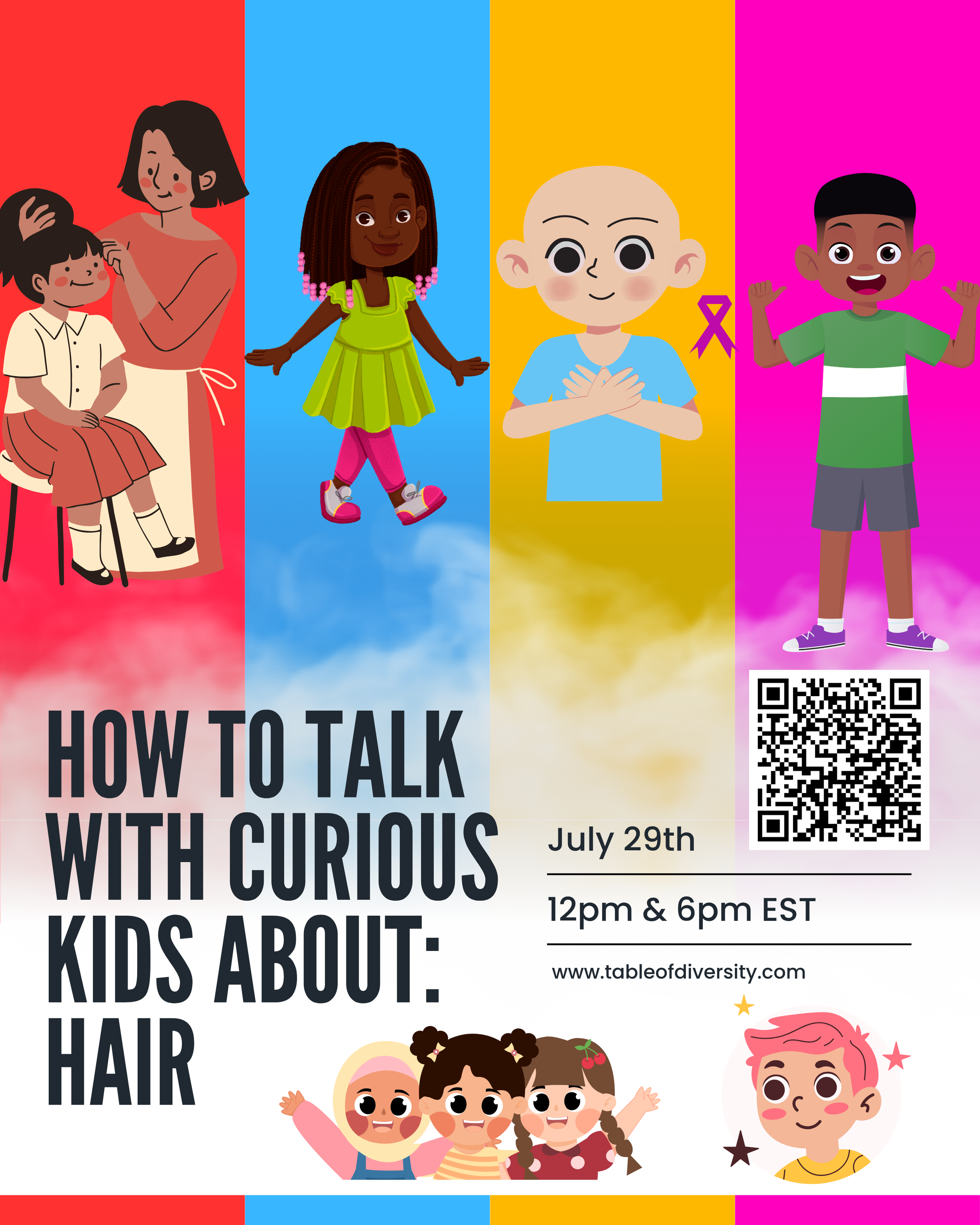
How to Talk With Curious Kids About: Hair! A Live Conversation!
Built for curious kids. It works with curious adults too.
Back-to-school season is when kids are growing into their own personhood, noticing their hair, other people's hair, and everything hair says about identity, culture, and belonging. It's the perfect moment for this conversation.
This isn't a script of "what to say,” although the Practice Guide can provide some quality conversation starters. This is a learning journey that meets you and your young person wherever you both already are by starting with curiosity about what they already know, building a safe space to learn together, and landing on kindness and inclusion toward people with all kinds of hair (color, texture, hair loss from medical conditions, hairstyles like braids and mohawks — this goes well beyond just one kind of hair story).
The transformation: You'll walk away not with a rehearsed answer, but with a muscle — the ability to be curious instead of assuming, to create safety instead of policing language, and to stay present in a conversation about hair (or anything else that looks different from your own experience) without freezing up. Practice it with a five-year-old, and you'll find yourself using it with your coworker, your in-law, your neighbor.
Why this matters for parents: Kids are already forming opinions about hair — their own and other people's — long before adults think to guide them. If you're not the one shaping that curiosity, the internet, their peers, or silence will. This gives you a way in that doesn't require getting it "right," just getting present.
Why this matters for educators: Hair shows up in classrooms constantly — a comment at recess, a question during read-aloud, a kid touching another kid's braids without asking. You don't always have the luxury of prep time. This gives you the instinct to handle it in the moment, safely, for every kid in the room.
Why this matters for curious adults: You don't need a kid in your life to need this conversation. The same discomfort that shows up when a five-year-old asks a blunt question about hair shows up at work, at family dinners, with a new friend — curiosity instead of assumption, safety instead of policing language. This gives you permission to be curious out loud, without needing to already have the "right" words.
What you'll explore:
How to ask questions that reveal what someone already knows or assumes
How to build a safe space for open conversation — with a kid or a colleague
Modeling kindness and inclusion across all hair types, textures, colors, and styles
Resources for continuing the journey, at home and beyond
How to Talk With Curious Kids About: Hair! A Live Conversation!
Built for curious kids. It works with curious adults too.
Back-to-school season is when kids are growing into their own personhood, noticing their hair, other people's hair, and everything hair says about identity, culture, and belonging. It's the perfect moment for this conversation.
This isn't a script of "what to say,” although the Practice Guide can provide some quality conversation starters. This is a learning journey that meets you and your young person wherever you both already are by starting with curiosity about what they already know, building a safe space to learn together, and landing on kindness and inclusion toward people with all kinds of hair (color, texture, hair loss from medical conditions, hairstyles like braids and mohawks — this goes well beyond just one kind of hair story).
The transformation: You'll walk away not with a rehearsed answer, but with a muscle — the ability to be curious instead of assuming, to create safety instead of policing language, and to stay present in a conversation about hair (or anything else that looks different from your own experience) without freezing up. Practice it with a five-year-old, and you'll find yourself using it with your coworker, your in-law, your neighbor.
Why this matters for parents: Kids are already forming opinions about hair — their own and other people's — long before adults think to guide them. If you're not the one shaping that curiosity, the internet, their peers, or silence will. This gives you a way in that doesn't require getting it "right," just getting present.
Why this matters for educators: Hair shows up in classrooms constantly — a comment at recess, a question during read-aloud, a kid touching another kid's braids without asking. You don't always have the luxury of prep time. This gives you the instinct to handle it in the moment, safely, for every kid in the room.
Why this matters for curious adults: You don't need a kid in your life to need this conversation. The same discomfort that shows up when a five-year-old asks a blunt question about hair shows up at work, at family dinners, with a new friend — curiosity instead of assumption, safety instead of policing language. This gives you permission to be curious out loud, without needing to already have the "right" words.
What you'll explore:
How to ask questions that reveal what someone already knows or assumes
How to build a safe space for open conversation — with a kid or a colleague
Modeling kindness and inclusion across all hair types, textures, colors, and styles
Resources for continuing the journey, at home and beyond